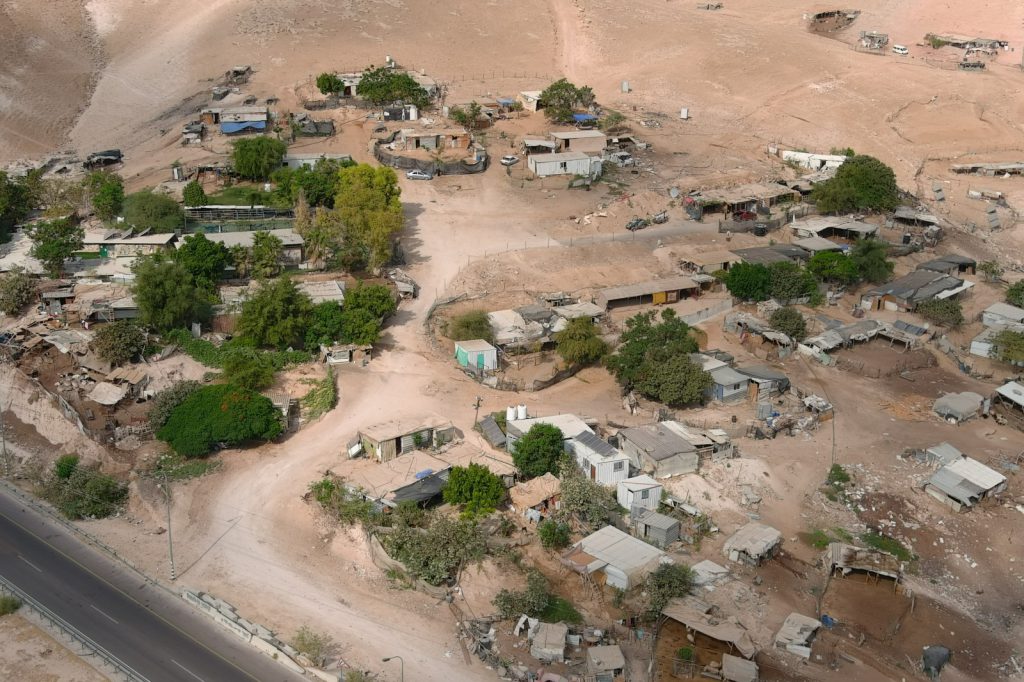
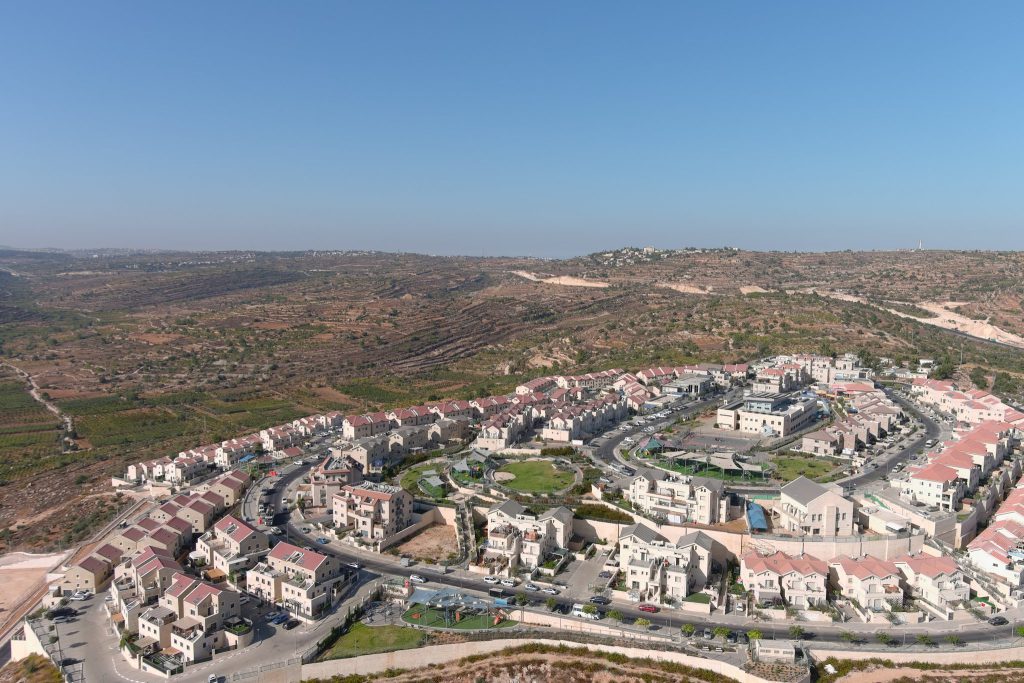
In the heart of the Land of Israel, an exclusive new housing project is underway. To qualify for this prime location you must have Jewish blood on your hands: Eligibility is for those who have served a minimum 5-year prison sentence in an Israeli security prison.
Recently, work began on a new neighborhood of 100 luxury villas in Area B – the portion of Judea and Samaria under Palestinian Authority civil jurisdiction and Israeli security jurisdiction.
The project developer, the Ramallah-based “Al Karameh Corporation for Prisoner Housing,” is an association whose members have served sentences of at least five years in Israeli prisons for terror-related convictions. The governing board of the corporation boasts family members of notorious terrorists, including Ablah Saadat, wife of Ahmad Saadat, Secretary General of the People’s Front for the Liberation of Palestine, and Naim Al-Sharif, father of Imad Al-Sharif, a convicted Hamas terrorist.
The new neighborhood has a commanding position overlooking Route 60 at the British Police Junction. This is the spot from which countless terrorist incidents have been launched, including in 2002 when an Palestinian-Arab sniper murdered 7 IDF soldiers, 3 civilians and injured 6 others.
Construction underway in the new neighborhood
This proves unequivocally that those calling upon Israel and the world to prop up and even strengthen the Palestinian Authority are completely out of touch with reality. It is high time that we understand precisely who and what we are dealing with: The Palestinians – both the leadership and the rank and file civilian population – idolize terrorists and consider them freedom fighters and martyrs, while the Israeli government agonizes over the morality of deporting the families of terrorists or of instituting the death penalty.
While all this hand-wringing and moralizing is going on, terrorism continues to claim the lives of Israelis throughout the Land of Israel, and the bloody tally of Jewish victims continues to swell.
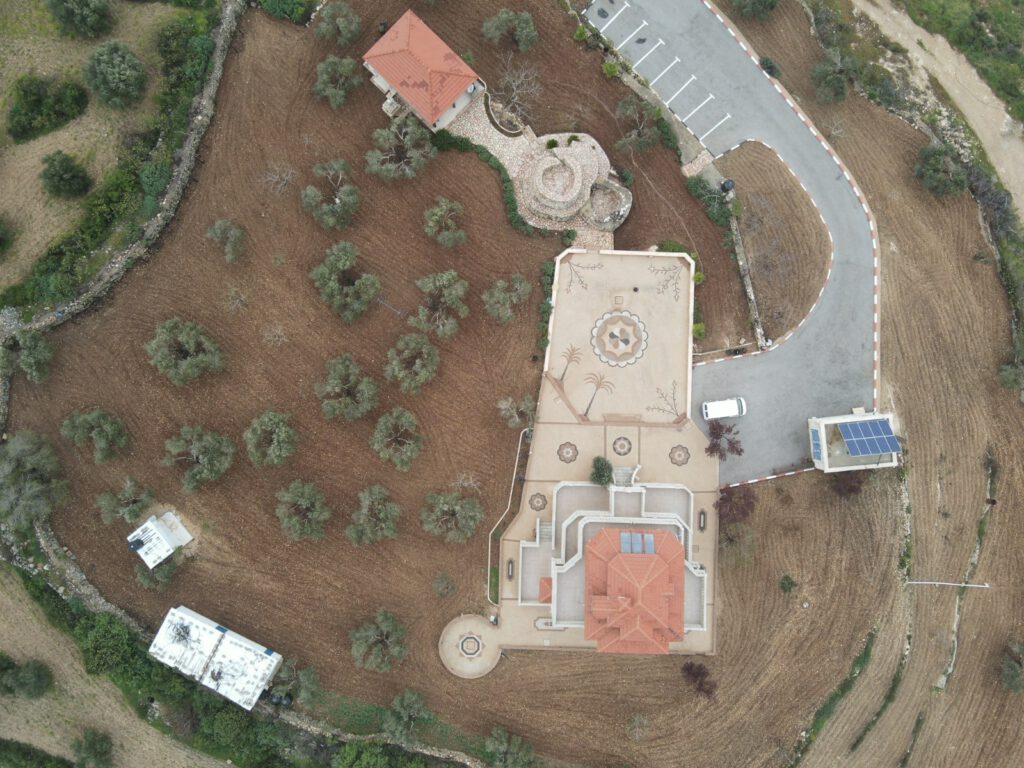
An aerial view of an illegal house – built for terrorists
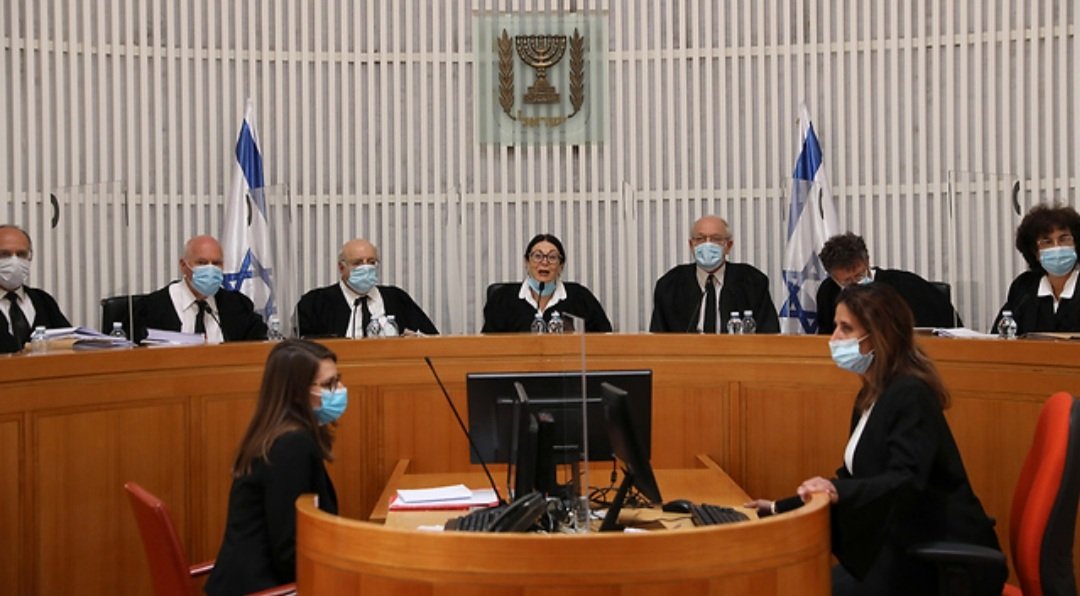
In the case of Jordanian Law #40, the racist law still in force that prevents individual Jews from buying land in Judea and Samaria, the High Court of Justice claimed that there is no justifiable reason to intervene. When Regavim petitioned against the law, the High Court judges sent us to the legislator.
However, in two other cases, the High Court deemed it right to intervene: when a Jewish community refused to allow an Arab to move in, the judges ruled that he can live there (the Kaadan case); and when a Jew requested to lease land in a Bedouin town, the Court rejected his petition (the Avitan case).
The High Court of Justice intervenes in government and Knesset decisions only if they seem unreasonable. But it’s clear that the question of what’s reasonable or not depends on your political outlook. If it is *reasonable* to cancel the law against infiltration in Israel and *unreasonable* to cancel a racist law which prohibits the sale of property to Jews, what does that say about “reasonableness” in the eyes of the justices?
Purim is over. It’s time to take the masks off, and restore the balance between the different branches of Israeli government.
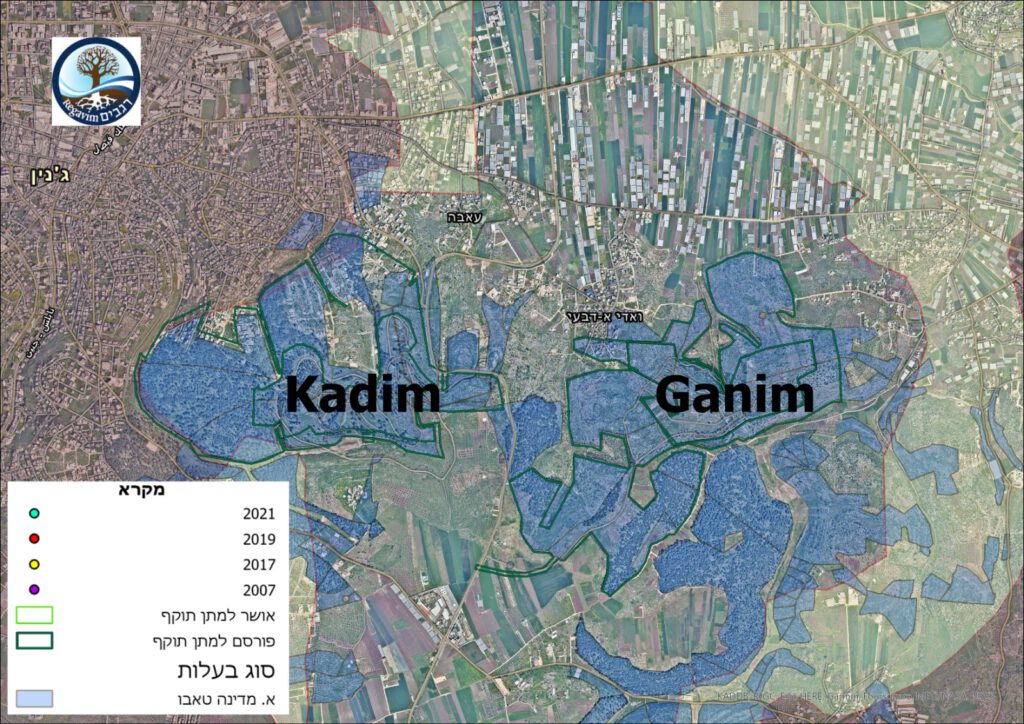
Aerial documentation of illegal construction on the ruins of the the northern Shaomron communities
In a hearing of the Foreign Affairs and Defense Committee on the repeal of the Disengagement Law, Avraham Binyamin last week, Director of Regavim’s Policy Division, presented documentation of massive illegal Palestinian construction in northern Samaria in general, and particularly on the ruins of the Ganim, Kadim and Sa-Noor communities that were de-populated as part of the 2005 disengagement plan. The aerial photographs presented to the Committee show thousands of illegal Arab structures in Area C, the portion of Judea and Samaria under full Israeli jurisdiction – hundreds of them built only in the past year.
Far worse than the staggering quantity of this illegal construction is its strategic quality: These illegal structures create a land bridge between blocs of Palestinian Authority-controlled Area B settlements, undermining the Oslo framework that left the question of territorial contiguity under Palestinian Authority control for a negotiated resolution.
“The 2005 Disengagement Law is one more element abetting the creation of a terrorist state in the heart of the Land of Israel,” said Binyamin, who presented aerial photos of large-scale illegal construction in the region. “The land on which the de-populated Jewish communities of northern Shomron once stood – Ganim, Kadim, Sa-Noor – have been overtaken by illegal Arab construction, despite the fact that the IDF ostensibly retains control of the territory.”
“By emptying the northern Shomron communities of their Jewish residents, the Disengagement Law opened the door for Palestinian Authority annexation of the territory which the Civil Administration has done absolutely nothing to prevent,” he added.
Meir Deutsch, Director General of Regavim, released a statement following the Knesset hearing: “Nearly a century ago, Joseph Trumpeldor summarized an essential truth of the Zionist ethos that is no less relevant today than it was in the pre-State era: “The place where the last row is plowed will be the border of our country.” Land on which there is no Jewish presence will be lost. Settlement and security are not only related, they are inseparable.”
“The false prophecies of the architects of the “disengagement,” who claimed that ceding territory would enhance Israel’s security, continue to blow up in our faces. Precisely because there is no longer a Jewish presence on the ground, there is no security. The borders of the State of Israel are being re-drawn by the Palestinian Authority – without negotiation, without compromise, in ways that threaten the security of the entire State of Israel. It is long past time to reverse this disastrous policy.”
Video: Avraham Binyamin’s presentation in the Knesset (Hebrew)
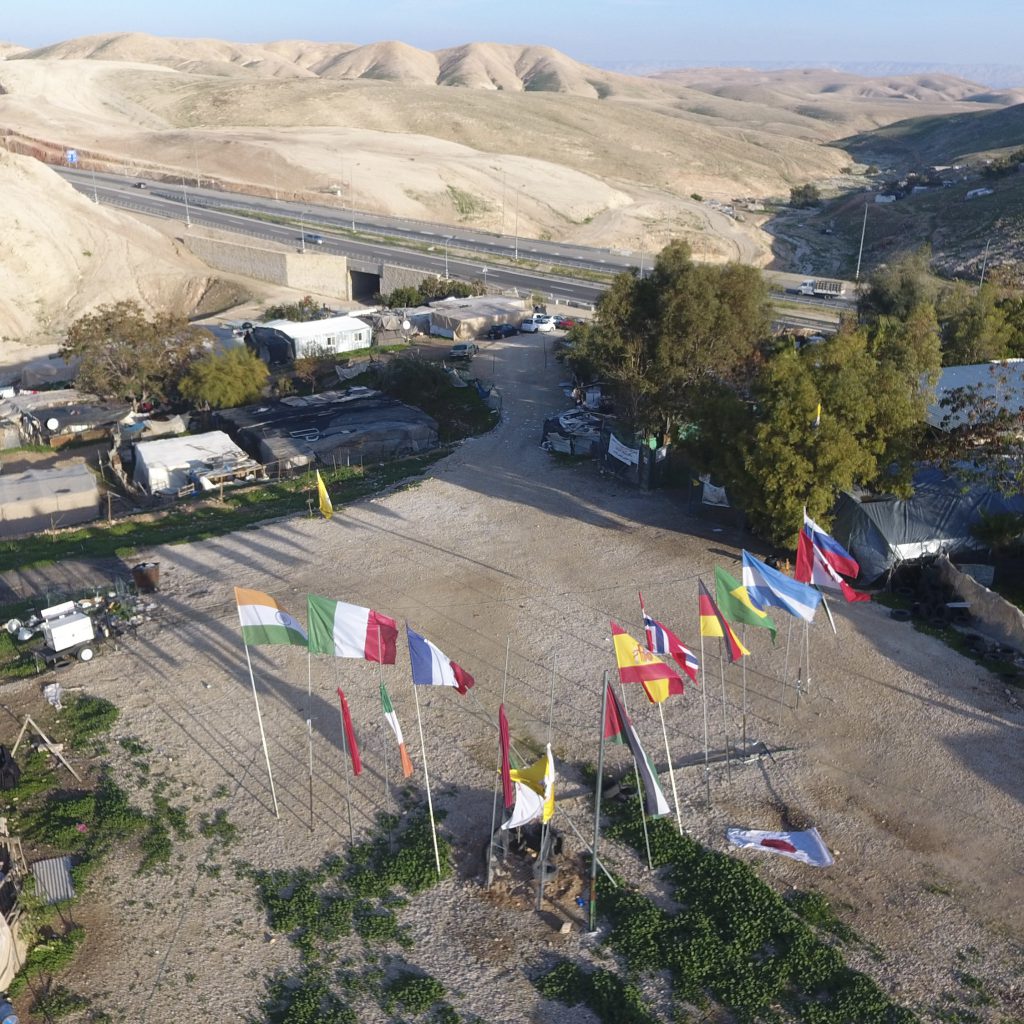
The illegal Bedouin outpost of Khan al Ahmar near Kfar Adumim
For the ninth time: the State of Israel asks the High Court to allow another postponement of its response to Regavim’s petition for the evacuation of the Palestinian Authority’s flagship outpost, Khan al Ahmar. Regavim: “A right-wing government is tested by deeds, not by words.”
The extension granted to the state four months ago to respond to Regavim Movement petition to relocate the Bedouin squatters of Khan al Ahmar ended today, and the state has requested an additional four-month extension to present its position.
“The political echelon remains steadfast in its position that the rule of law requires the demolition orders to be carried out in the Khan al Ahmar compound,” according to the state’s request, adding that in the weeks since the formation of the present government, the new head of the National Security Council, Tzachi Hanegavi, has been working in cooperation with the National Security Advisor, representatives of the Ministry of Defense, the IDF, the General Security Service (Shin Bet), the Ministries of Foreign Affairs and Justice, and other government representatives.
“The details of this intensive effort speak to the complexity, sensitivity and importance that state officials attach to compliance with the conditional orders already issued in this matter, as well as the fact that the issue is a high priority… On the other hand, given the complexity of the issue and its sensitivity, the high level of interest in the international community and the and implications for the foreign relations and security of the State of Israel at the present time, those charged with handling this case at the professional level have been instructed to complete all necessary steps required to formulate an appropriate response to the conditional order as soon as possible. The formulation of a detailed response on such a sensitive and complicated issue justifies the position of the political echelon that an additional stay be granted to enable the professionals to complete their work and to submit a comprehensive analysis to the political echelon.”
The Regavim Movement issued a strongly-worded statement criticizing the postponement request. “We were hoping for an appropriate response by a national right-wing government – as promised in the election campaign,” said Meir Deutsch, Director General of Regavim. “There is no justification for this. Like Cato in ancient Rome, we continue to repeat the same demand, to hold the same consistent position, to call upon our representatives in the government to act immediately to evacuate this illegal encampment – as well as dozens of other Palestinian Authority outposts created in the same mold – not 300 meters away from its present location, but to the neighborhood prepared precisely for this purpose near Abu Dis.”
Regavim responded to the state’s request for postponement by calling on the High Court to issue a final order, as it intimated it would when it granted the previous postponement, and put an end to the saga once and for all. “This is an extreme case of ‘lack of reasonableness’,” added Deutsch. “After all is said and done, this case will prove whether the High Court applies the same standard of reasonableness to cases from both sides of the political divide, or whether the reasonableness standard is nothing more than a judicial fig leaf for a particular agenda. We await a final judgement for the relocation of the Khan al Ahmar outpost in a manner that is consistent with Israel’s national interests.”
Interview: Regavim’s Naomi Kahn speaks to Kan English Radio about Khan al Ahmar postponement
This morning (Monday), Likud MKs Danny Danon and Yoel (Yuli) Edelstein joined the Regvaim Movement and the Jerusalem Environs Forum – and faced by a pro-Palestinian demonstration. Regavim: “The question isn’t whether or not, but how and when the outpost will be evacuated.”
The deadline for the state’s response in the Khan al Ahmar case is rapidly approaching – and the political pressure is climbing. This morning (Monday), World Likud Chairman MK Danny Danon and Chairman of the Knesset Foreign Affairs and Defense Committee MK Yoel (Yuli) Edelstein were joined by Likud activists on a tour of Khan al Ahmar hosted by the Regavim Movement and the Forum for Jerusalem Satellite Communities. A group Palestinian Arab and leftist activists protested nearby, waving Palestinian flags.
Less than 2 weeks remain for the state to submit its response to the High Court of Justice in the sixth petition submitted by the Regavim Movement regarding the illegal outpost adjacent to Route 1, the main access road connecting Jerusalem to the Dead Sea and Israel’s eastern border. This most recent deadline marks the eighth time the state has delayed compliance. The fast-approaching deadline of 1 February is the ninth such extension granted by the High Court – which also declared that it would be the last.
MK Danny Danon: “I have come here today to strengthen our government as it prepares its response to the High Court regarding the evacuation of this site. Israel is a state governed by law and order, and we must not accept selective enforcement. Khan al Ahmar must be evacuated immediately. I am well acquainted with the international community. Our friends around the world will understand that there can be no place for selective enforcement that discriminates against Jews in Judea and Samaria.”
The illegal outpost of Khan al Ahmar next to Route 1, east of Jerusalem, September 2022
Meir Deutsch, Director General of Regavim: “The State of Israel must understand that this is a mega-issue that goes far beyond the Khan al Ahmar outpost. Our annual documentation and mapping of the illegal construction in Area C proves that in the past decade the Palestinian Authority has taken tremendous strides toward establishing a de facto state in the heart of the Land of Israel – and the government is simply closing its eyes to reality.”
“The new government must prove to the voters who elected them that it is a real Zionist nationalist government – and place the Battle for Area C at the top of the agenda. The question regarding Khan al Ahmar is no longer whether the outpost will be evacuated, but when and how.”
Recent pictures of illegal gas stations in the Negev
While the cost to fill up your car continues to rise, there are those living in a parallel universe – in Bedouistan.
For many years, Regavim has been sounding the alarm bells about the phenomenon of dozens of illegal gas stations that are scattered throughout the Negev. Even when Police forces manage to shut one down, three new ones appear.
These gas stations don’t meet any regulatory standard, endanger lives, damage the environment, and bring in millions of shekels for criminal organizations that avoid tax payments.
This is another major task for the new government and Knesset: to restore governance in the Negev and the Galilee.
Learn more about the lawlessness and lack of governance in Israel’s Wild South in “Bedouistan” – the book published by Meir Deutsch, Regavim’s Director General. Place your order here.
To mark the 49th anniversary of the passing of David Ben-Gurion, we launched our “Sde Boker Initiative.” This comprehensive roadmap for the future of the Negev is the result of 16 years of fieldwork, analysis, legal research and activism that have enabled us to formulate a vision for the future, looking ahead to 2050 through the prisms of national planning and development imperatives, improved governance and resolution of land ownership claims.
Over the past year, we presented the Sde Boker initiative to each of the Zionist parties in the Knesset, and immediately after the establishment of the new government, we have begun to present it to the general public. Many members of the new government view the plan favorably, and we will continue to push for implementation of its core recommendations.
To view a summary presentation of the Sde Boker Inititiative, click here.
Naomi Kahn, Regavim’s International Director, was in Toronto for a speaking tour last week, and met hundreds of people from the local Jewish community to discuss issues such as governance and sovereignty in the Negev and in Judea and Samaria, and about Regavim’s activities in general.
Naomi also encountered hostile, anti-Israel organizations and BDS activists who called to boycott her visit and block tax-exempt donations to Regavim from Canada.
We won’t allow extremist organizations and activists to silence us and take away our right to share our views, data, and research anywhere we choose. We welcome debate, discussion, and disagreement – but we refuse to allow fanatical political movements to dictate what we can and cannot say.
In response to those who wish to silence Regavim, we invite you to support our activities. Make an online, tax-deductible donation here.
Israeli town of Efrat, a six-minute drive from Jerusalem, and the hill upon which a new neighborhood, Givat Eitam, is to be built.
This evening (Tuesday) the High Court of Justice rejected a “Peace Now” petition arguing that Israel’s land allocation policy in Judea and Samaria is discriminatory and demanding that territory be granted to Palestinians in Efrat. Regavim: “As far as the left-wing organizations are concerned, no tactic is off limits when it comes to harming the State of Israel.“
A panel of Supreme Court judges led by Chief Justice Esther Hayut today rejected a petition filed by Peace Now on behalf of Arab residents of Bethlehem, claiming discrimination in Israel’s land allocation policy. In an earlier stage of the case, Israeli authorities proposed that the Palestinians submit a request for allocation of a 51 dunam plot in the area designated for Efrat’s newest neighborhood; representatives of Peace Now rejected the proposal, claiming that it is “not even a Band-Aid on the systemic discrimination.”
The current petition, submitted on behalf of 13 Arab residents of Bethlehem, demanded that the state allocate land in the area of a future neighborhood of the Jewish community of Efrat, the Eitam Hill. The petition made a precedent-setting argument against Israel’s land allocation policy in general, claiming that there should be parity between land allocations for Jewish and Arab use in Area C, the portion of Judea and Samaria under full Israeli jurisdiction.
The petition followed a long and winding legal battle, with roots dating back some 30 years to the establishment of Efrat on state land in Gush Etzion. “This petition represents a new tactic: In addition to the back-door methods of Palestinian annexation – illegal construction and agricultural landgrabs – Peace Now is trying to open the front door for the Palestinian Authority’s takeover of Area C through Israel’s High Court,” explained Avraham Binyamin, Director of Policy and Parliamentary Affairs at Regavim. “The petition argues that the state discriminates against the Palestinians in the way it allocates land – but completely ignores the reality on the ground, in which the Palestinian Authority already controls nearly half of Judea and Samaria, and has vast available land reserves to which Jewish residents have no access.”
Binyamin added: “Far-left organizations will stop at nothing in their attempts to torpedo the growth of Jewish communities on the one hand, and promote the Palestinian takeover of Judea and Samaria for a Palestinian state, on the other hand. As far as they are concerned, any and all means, including causing harm to vital Israeli interests and causing harm to Israel’s reputation and integrity, are acceptable.”
The High Court rejected the claim of discrimination, noting that the state had, in fact, opened the door to Palestinian requests for land allocations.
Attorney Boaz Arzi of Regavim’s Legal Division noted that although the High Court rejected this petition, the state took its first step on a slippery slope by declaring that it will, under certain circumstances, agree to allocate land in Area C to Arab petitioners. “There is absolutely no justification for giving land away, for ceding control of vital state assets to the Palestinian Authority’s control, when there is more than enough land available in Areas A and B to provide for the needs of the Arab population. The land involved in this petition has been part of the municipal property of Efrat for years; the Arabs have been trying to lay their hands on it by every means possible – through illegal construction, through agricultural land-grabs, and now, through the Israeli courts.”
“The Peace Now campaign against the establishment of the Eitam neighborhood has been going on for decades,” noted Meir Deutsch, Director General of Regavim. “From the start, it has been riddled with distortions, half-truths and outright lies. We can only hope that the High Court’s rejection of this most recent attempt will put an end to the saga, and will clear the smokescreen that is used by the anti-Israel left to delegitimize Jewish community-building in Judea and Samaria and to defame the State of Israel.”
Regavim’s video from May 2022 that explains Law 40
The High Court of Justice rejected the Regavim Movement’s petition to repeal Jordanian Law #40 which prohibits the sale of property in Judea and Samaria to Jews, on the grounds that “there is no call for intervening in matters of state”: “Despite the difficulty we have in coming to terms with the language of the law, there is no justification for this Court to intervene.” Regavim: “The High Court is enabling appalling discrimination. This is the first test of the new government’s mettle.”
Yesterday (Wednesday), the High Court of Justice rejected a petition filed by the Regavim Movement to compel the military commander and the Civil Administration to repeal Jordanian Law #40 which prohibits the sale of land in Judea and Samaria to Jews – a law still in force due to Israel’s decision not to extend its law or sovereignty to territory liberated in 1967.
In the High Court hearing earlier this week, Regavim’s attorney, Boaz Arzi, argued that this patently racist law should be struck down without further delay. In an earlier stage of the case, the High Court issued a conditional order requiring the government to respond within 60 days and explain why this discriminatory law should be allowed to stand. The attorney representing the Civil Administration argued that no real harm is caused by Jordanian Law #40 to Jews who wish to carry out real estate transactions in Judea and Samaria: the state’s work-around solution allowing would-be buyers to incorporate as a legal entity in Judea and Samaria in order to circumvent the antisemitic restriction against individuals, they argued, was sufficient. Regavim’s attorney responded: “Focusing on the quantity of transactions obscures the real issue. This is racism.”
The government’s representatives also argued that a committee, headed by the Assistant Minister of Defense, had examined the issue and determined that the restriction is “minor” while the level of political sensitivity regarding land in Judea and Samaria is immense. Therefore, the state argued, there is no justification for the Court to intervene in decisions taken by the military commander. Justice Groskopf noted, “The law is racist; that is clear. However, the cost outweighs the benefit. Essentially, the question is whether the considerations of the military commander in this matter are reasonable or unreasonable to the extent that the intervention of the Court is necessary.” The panel of three Justices accepted the State’s argument and rejected Regavim’s petition.
Jordanian Law #40 prohibiting the sale of property to non-Muslims was passed in the 1950s, during the illegal Jordanian occupation of Judea and Samaria following the War of Independence. Although the occupation came to an end in 1967, Israel refrained from extending sovereignty to the territories it had liberated, holding them in a “temporary” state of limbo in order to negotiate a political resolution to the conflict. Ever since, land purchases for Jewish settlement and development has been carried out through a bureaucratic-legal process designed to circumvent, but not annul, the anti-Jewish Jordanian law. In 1971, the IDF Chief of Central Command issued an order permitting commercial entities to purchase land in the area; individual Jews are barred from purchasing land to this very day. Regavim argued that the technical difficulties created by this “work around” are significant – and are nonetheless overshadowed by the inherent racism underlying the law itself, and the violation of Jews’ basic rights.
“This is an outrage,” says Meir Deutsch, Director General of Regavim. “For the first time, the High Court of Justice is upholding and permitting continued racial discrimination, hiding behind supposed diplomatic repercussions. No such discrimination against Arabs would be allowed, even if the government argued that there would be certain political or diplomatic fallout.” Deutsch added, “Can you imagine if the US Supreme Court had argued that because public transportation was readily accessible for black people, the cost of allowing them to use the front of the bus outweighed the benefit that would be achieved by judicial intervention?! If the Justices of Israel’s Supreme Court had been on the bench in the US, Rosa Parks and all those who came after her would probably still be on the back of the bus, and racial discrimination would still be the law of the land.”
“Law is an expression of a society’s values,” said Attorney Boaz Arzi. “Are these the values that we expect our justice system to uphold? We call upon the newly-elected government to reassert Jewish rights and the foundational principle of equality under the law that are the bedrock of the modern Jewish and democratic State of Israel.”