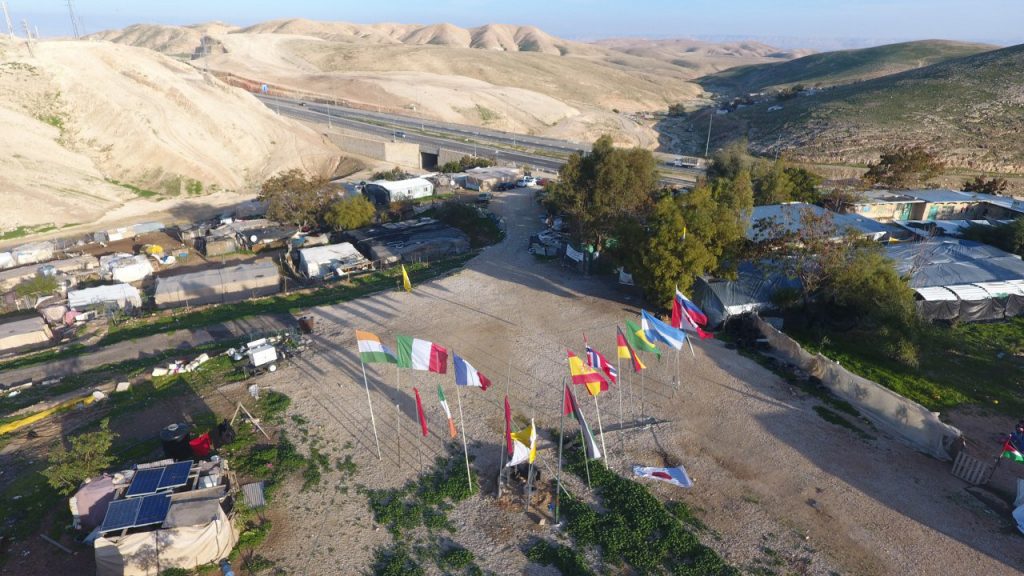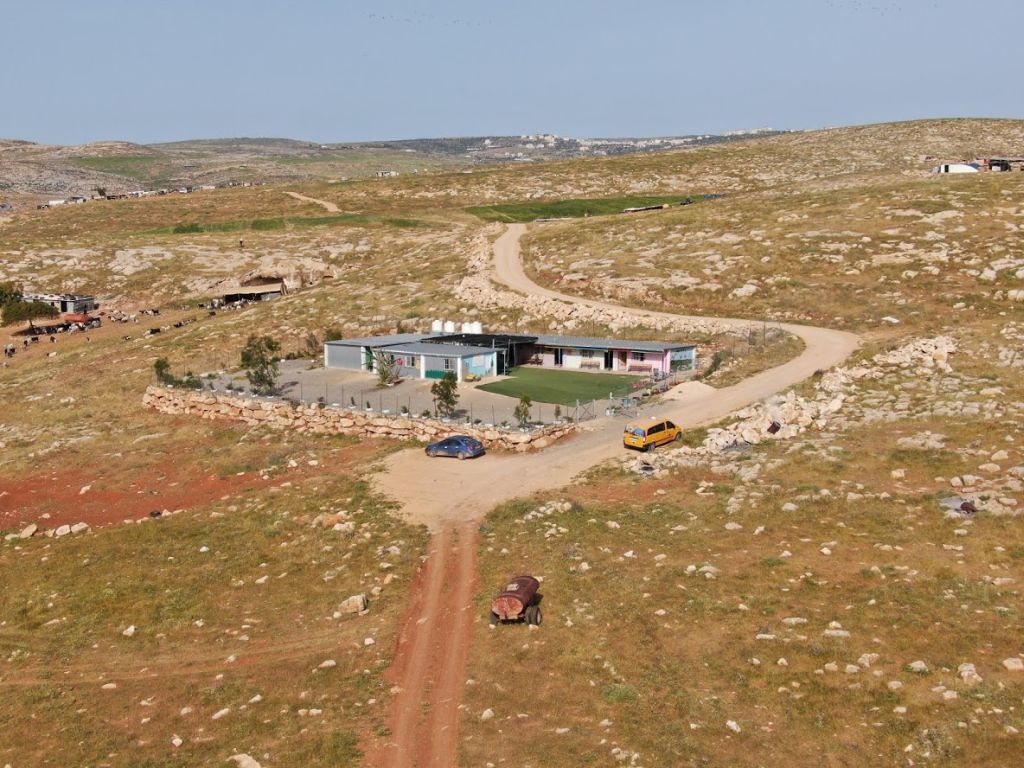
At the largest illegal dump in Judea and Samaria, untreated waste continues to pollute the entire ecosystem – and no indictments are in sight.

Under cover of the first corona shutdown, the Ramallah Municipality dumped thousands of truckloads of untreated refuse into an abandoned quarry at the headwaters of Nahal Makoch. The Civil Administration admits: Only three trucks were impounded, and no indictments were filed against the criminals. Regavim: “The mountain of waste remains, despite the Civil Administration’s claims to the contrary.”

The mountain of waste dumped during the first corona lockdown by the Ramallah Municipality at the Nahal Makoch water basin is made up of more than 10,000 cubic meters of household and industrial waste. More than six months after the Regavim Movement filed an official complaint, “Mount Trashmore” remains precisely as it was, and in an official response to Regavim’s recent query, the Civil Administration admited that no indictments have been filed against those responsible for this environmental disaster.

Last year, during the first closure imposed to combat the spread of the corona virus, the Ramallah Municipality took advantage of the furlough of enforcement inspectors, and over the course of just a few weeks, thousands of garbage trucks dumped their contents into an abandoned quarry located only hundreds of meters from Binyamin Region Police Headquarters.

Last summer, after Regavim sent an urgent alert to the Civil Administration (CA), which is responsible for law enforcement in the area, the CA replied that they had halted all further dumping at the site and had carried out a number of enforcement actions. Regavim submitted a freedom of information request, to obtain details of the enforcement activity. From the CA’s reply, received earlier this week, we learned that in fact only two garbage trucks and an excavator were impounded, and the vehicles’ owners were charged only for the impound expenses.

The Civil Administration admitted that although the perpetrators were caught in the act, no indictments have been filed against them. In addition, the huge mountains of trash have not yet been removed from the area, contrary to the Civil Administration’s statement that “the owner of the machinery is required to remove the waste and level the area,” and that “these steps were completed out some time ago.”

“Almost a year has passed, and not one of the authorities responsible for dealing with hazards of this nature has taken responsibility,” explains Eitan Melet, Regavim’s Field Coordinator for Judea and Samaria. “The criminals got off virtually scot-free, with no criminal indictments, no clean-up costs, no punitive fines – but the entire ecosystem is paying a heavy price. The heaps of untreated garbage contaminate the topsoil, and runoff flows into the nearby creek channel, seeping into the groundwater, polluting the Makoch Valley and Wadi Qelt. This is eco-terrorism, and the official bodies that should be responding to it with swift, decisive action to repair the environmental damage and create a deterrent for other eco-criminals – the Ministry of Environmental Protection and the Civil Administration – are allowing this monumental failure to persist.”
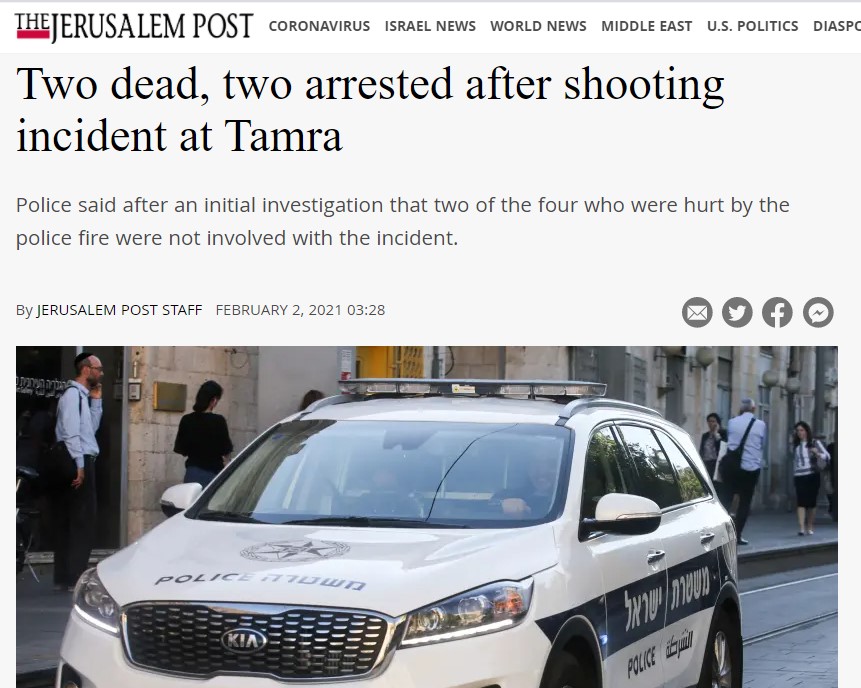
Following last night’s events in Tamra, an Arab town in northern Israel, the Regavim Movement applauds the decisive law enforcement activity by the Israel Police and calls on the leaders of the Israeli-Arab sector to support Israel Police efforts to eradicate organized crime.

In recent weeks, the Israel Police have carried out extensive – and long overdue – enforcement activity against organized crime operations and operatives, focusing on the scourge of illegal weapons in the Arab sector. After years of inaction that took a heavy toll on Arab society and both symbolized and contributed to the erosion of governance and Israeli sovereignty, these enforcement sweeps mark a change of course.

“The circumstances of the death of Ahmad Hijazi, who was killed last night during the exchange of fire between the police and criminal organizations, must be thoroughly investigated. That said, the complexity and difficulty of restoring law and order to Israeli Arab towns and villages should not be underestimated,” said Yakhin Zik, Director of Operations at Regavim. “The citizens of Israel who live in these communities continue to pay a high price for the years of inaction, and rooting out the criminal elements will be a long and challenging process.”

“The Regavim Movement has been monitoring and documenting the deterioration of the rule of law for years – and have often been harshly criticized for doing so. We are gratified that the Israeli government has begun to address the harsh reality that we have described for far too long.”

“Regavim applauds Minister of Internal Security Amir Ohana, and the Israel Police for their determined efforts in this Sisyphean task,” added Zik. “We hope that the important steps that have been taken thus far to restore governance and security will continue, and we call upon the leaders of Israel’s Arab sector and members of the Knesset to give their full support to the Israel Police efforts to battle organized crime in their community.”

Mazal tov to Regavim! We’re celebrating 15 years of Zionist activism.

This evening, we begin the festival of Tu B’Shvat, which coincides with the 15th anniversary of Regavim. Tu B’Shvat is the day on which the People of Israel celebrate the Land of Israel and the rebirth of its natural beauty.

Over the last 15 years, we’ve had the honor of working to promote Zionist land policy throughout the Land of Israel, the ancestral homeland of the Jewish nation. Our daily work – in the field, in the Knesset, in the courts, in the media and on social networks – all serves one goal: protecting Israel’s most valuable resource – the land itself.

On a daily basis, we share with you the big and small stories that slowly lead to change on the ground. As we mark Regavim’s ‘New Year’, we’ve prepared a comprehensive Annual Report so you can get a better picture of what we’ve done over the last 12 months >> click here

And of course, our battle for our beloved homeland and its resources, and for the rule of law that must protect them, could not happen without you, our friends, supporters, and donors worldwide. Please continue to take an active part in our efforts, for the sake of our shared birthright and for the generations to come. To donate click here.

Regavim: Protecting Israel’s Resources, Preserving Israeli Sovereignty

PA ‘celebrates’ Tu b’Shvat near Rosh HaAyin

Yesterday (Sunday 24 January), the Palestinian Authority planted thousands of trees on Israeli state land, in an IDF firing zone. Participating in the event were armed Palestinian Police. Regavim: “While they’re establishing facts on the ground, the Israeli authorities are in winter hibernation.”

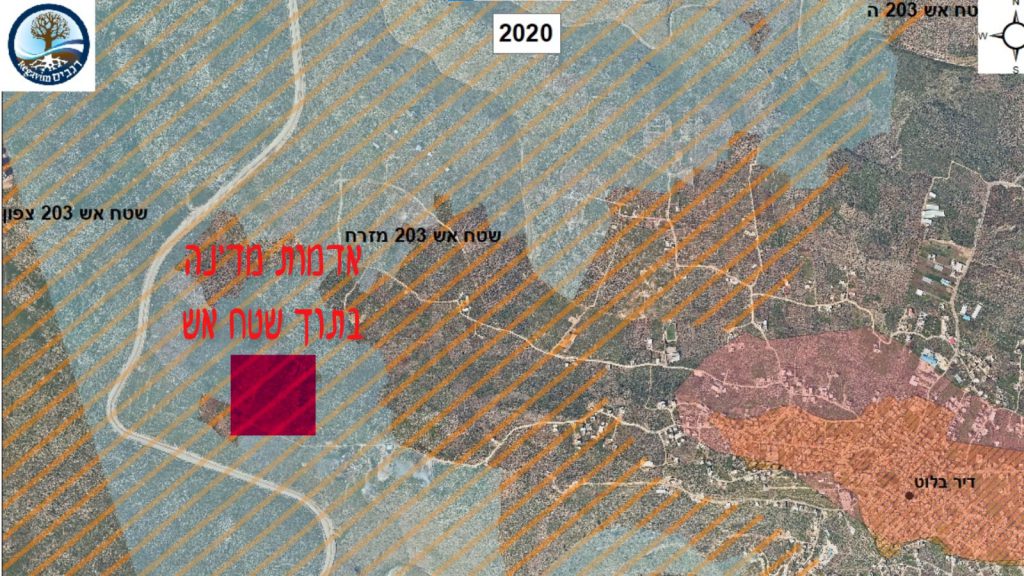
The Palestinian Authority held a ceremony yesterday (Sunday), planting some 2000 olive trees on Israeli state land, in IDF Training Ground 203 – adjacent to Rosh HaAyin to the east and Dir Balut in the west, in close proximity to the security barrier.

The event was filmed, photographed and publicized by Fatah– affiliated Radio Zeituna and on social media. Armed Palestinian Police officers were among those in attendance, and were filmed as they entered the IDF firing zone – despite the fact that are prohibited from entering Area C, the section of Judea and Samaria under Israeli jurisdiction.

This event is one element of a large-scale project that has taken shape over the past several years, in which the Palestinian Authority has planted millions of trees as a means of illegally seizing control of thousands of dunams in Area C.

The Palestinian Authority’s “agricultural annexation” focuses on land adjacent to roadways, surrounding Jewish communities, as well as state land – particularly in locations that are of high strategic and political importance.

“The Palestinian Authority has joined the Tu B’Shvat celebrations with well-planned ‘agricultural conquest’ projects – and thus far, the State of Israel is fast asleep,” said a spokesperson for Regavim. “These projects are supported by massive European funding, and the targeted locations are chosen with care to serve a clear and publicly-declared purpose: changing the map, by creating facts on the ground – and all within spitting distance of Rosh HaAyin and Gush Dan.”

Cover of Regavim’s 2018 report on High Court bias

Yesterday (January 11), a new poll was published by the Israel Democracy Institute reflecting a dramatic drop in the Israeli public’s trust in its government systems. One glaring finding shows that only 42% of the public express trust in the High Court of Justice, Israel’s highest court.

To bring this problem into clear focus, it’s worth analyzing this statistic through the prism of political affiliation. While 84% of those who identified as left-wing expressed trust in the High Court of Justice, only 38% of those who self-identify as right wing expressed similar trust.

How has it come to this?

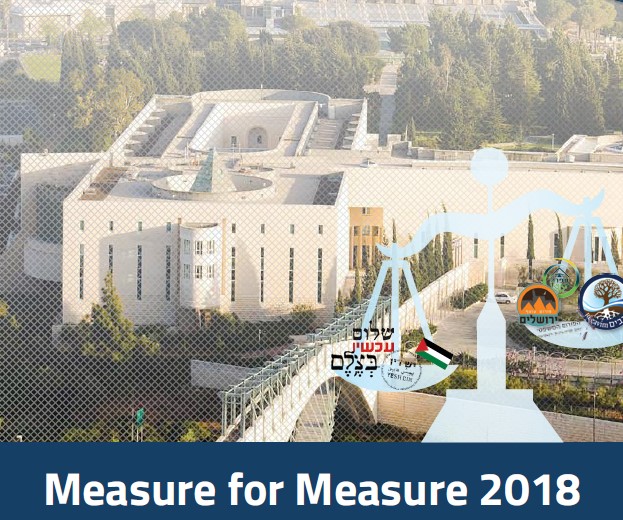
For 15 years, Regavim has been speaking – and proving- the uncomfortable truth: the High Court of Justice is politically biased. It’s not a hunch or a subjective impression; Regavim has presented actual, empirical and undeniable evidence of the HCJ’s bias in three separate reports spanning over a decade.

We analyzed more than 110 petitions, submitted to the High Court of Justice by both left- and right-wing appellants over a period of 18 years. All of the cases involved illegal construction in Judea and Samaria, and in each case the petitioners claimed that the Civil Administration had failed to enforce the law against the illegal construction.

Roughly half of the petitions were filed by left-wing organizations against Israeli communities, and the remaining half were submitted by Regavim and other Zionist organizations against illegal construction in the Arab sector in Judea and Samaria.

All the petitions dealt with extremely similar legal issues and based their arguments on the same points of law.

Regavim’s analyses examined the procedural aspects of these cases, rather than arguments presented or the rulings handed down. These procedural elements serve as a neutral indicator, reflecting the opening position for each petition and the basic, underlying attitudes of the judges toward the issue at hand.

Our findings painted a disturbing picture:

• In petitions filed by the left, the average time allotted by the Court for the defendants’ preliminary response was 18.5 days, while in petitions filed by the right, respondents were allotted an average of 30.5 days to respond – a disadvantage of 150% against right-wing petitions

• For right-wing petitions, the average time that elapsed between filing the petition and its first hearing was 342 days, some three months longer than the time elapsed for left-wing petitions to be heard (average of 248 days).

• Interim orders were granted in 84% of left-wing petitions in which they were requested, while right-wing petitions were granted interim orders in a mere 13% of cases.

• In right-wing petitions, the Chief Justice participated in the panel in only 21% of cases, as opposed to 58% of left-wing petitions, reflecting the importance attributed by the Chief Justice to each case.

• Of the 61 petitions filed by the right in which an order nisi was requested, the Court granted only one (1.7%). Of the 43 petitions filed by the left in which an order nisi was requested, the Court granted 19 (44%).

• The average number of hearings held by the High Court of Justice for petitions filed by the left was 2.64, as opposed to 1.06 hearings for each petition filed by the right.

• Left-wing petitions remained active over an average period of 33.3 months. On the other hand, the average life span of right-wing petitions was 16.7 months.

Small wonder, then, that fewer right-wing people believe the High Court to be impartial; their perception of unfair treatment by the legal system is borne out by the facts. A growing  majority of the Israeli public understands that High Court rulings are dictated not by the law, but by the personal politics and agendas of the judges. All too often, the outcome of a given petition is a foregone conclusion once the panel of judges is announced.

As if this weren’t bad enough, the Court’s bias continues to be compounded by the ‘judicial revolution’ launched  by former Chief Justice Aharon Barak, which paved the way for the judicial system to intervene in political realms that should be off-limits for non-elected officials. At the end of the day, legislators are elected and empowered by the public, and are held accountable by the public when they stand for re-election (which has been the case with alarming frequency recently!). Israel’s judges are appointed – in fact, they are, in effect, members of a self-selected elite. The public has no way to “un-elect” people who weren’t elected in the first place.

When lines are crossed, when personal bias and political agendas become so blatant that the public can no longer place its trust in the judicial system, we all have a problem – whether we consider ourselves “left” or “right”.

In order for trust to be restored, and in order to preserve our democracy and to restore a healthy balance between the different branches of government, Israel’s judicial system must be reformed. Until the process of judicial appointment is democratized and  the values of the entire Israeli public are represented on the bench, the public’s faith in our highest institutions will continue to decay – and with it, the very foundations of our democracy.

If you were asked to name a country where there is still a law in force that prohibits Jews from buying property, you might be tempted to make an educated guess based on the dark history of Europe and the long tradition of expulsion and persecution that was facilitated by anti-Jewish legislation over centuries. Places like Germany, England and France might spring to mind; Spain and Portugal might be in the running as well.

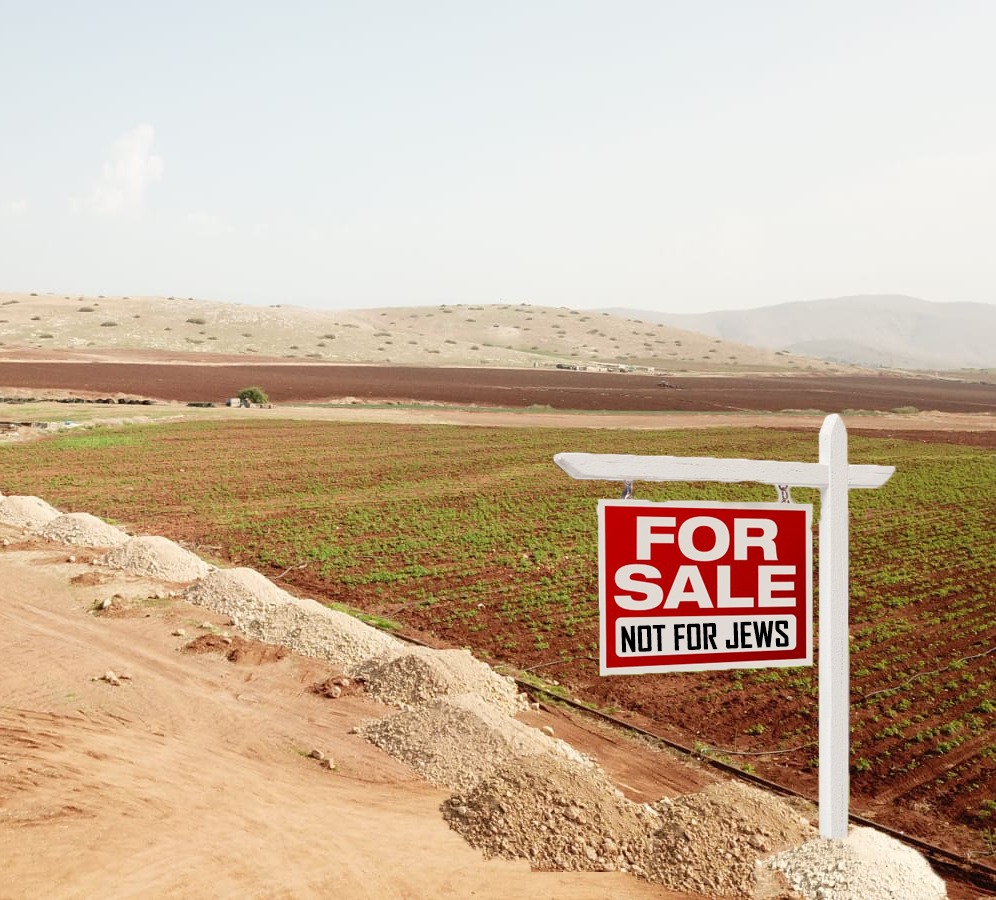
You probably wouldn’t guess that today, in the year 2021, a law is enforced by the State of Israel that prohibits Jews from purchasing privately owned property — but that is the sad and shocking truth. Law 40, enacted in 1953 by the Jordanians during their illegal annexation of Judea and Samaria, prohibits the purchase of privately owned land by non-Arabs, as well as the sale of privately owned land to non-Arabs (in other words, Jews). Not only is Law 40 still “on the books,” but it is actively enforced to this very day by the State of Israel’s legislative, judicial and security branches.

In a very real and undeniable sense, this legislation is, quite simply, racist. It is blatantly anti-Semitic. It is regressive, and an affront to the concepts of personal liberty, equality and property rights upon which democracy is based. Laws of this kind would not be allowed to stand anywhere in the civilized world, and it is nothing short of outrageous that the Jewish state has allowed this discriminatory and regressive legislation to remain in force in a judicial system that champions individual rights.

How, then, have Jews purchased property over the past 53 years? In 1971, the Military Commander for Judea and Samaria issued a “work-around” directive, by changing the Jordanian law that pertains to corporate ownership, while leaving Law 40 untouched. Thus, companies registered in Judea and Samaria — even if they are owned by Jews — are now permitted to purchase property in Judea and Samaria. Rather than strike down Law 40, the Israeli government has left it in place and designed a method of circumventing it.

Why, you may well ask? Why should this be necessary? Simply put, the State of Israel has spent decades avoiding any action that might be construed as an act of sovereignty in Judea and Samaria. It has bent itself into contorted legal positions in order to avoid fulfilling its most basic responsibilities to Israeli citizens and to the security of the State of Israel. It has procrastinated to the point of absurdity, creating a vacuum of governance and a black hole of law and order that continues to turn normal life — for Jewish and Palestinian residents of “Area C” alike — into a tangled bureaucratic nightmare.

The legal departments of both Israel’s Ministry of Defense and Civil Administration have recommended additional methods of circumventing or even amending Law 40. The Regavim Movement, on the other hand, has petitioned the High Court of Justice to strike down this racist legislation altogether, and to expunge this anti-Semitic vestige from the Israeli legal code. Striking down Law 40 is a statement of Israel’s commitment to equal and universal rights under the law — a statement that is long overdue.

“Meet Abed. Abed is an 18-year-old Bedouin who lives in an ‘unrecognized’ squatters’ camp in the Negev.

He’s a spontaneous, sensitive guy – and he’s nobody’s fool.”

Regavim’s video illustrates why, despite the state’s efforts to create legal, organized communities for Israeli Bedouin, complete with municipal infrastructure and modern services, these attempts have failed over and over again. What’s the bottom line? Who are the winners, who are the losers, and what are the consequences for the future of the Negev and the State of Israel?

The illegal Bedouin hinterland in the Negev is comprised of tens of thousands of illegal structures, and the State of Israel has been dragging its feet for years in a series of failed initiatives aimed at relocating the Bedouin to permanent, legal, organized settlements.

To encourage and enable the residents of the illegal encampments to relocate to organized towns with proper infrastructure, municipal services, education and health care facilities, the state provides each resident of the illegal encampments with a free, developed plot of land and a “relocation compensation payment” of hundreds of thousands of shekels – but because there are no timetables or deadlines attached to these generous relocation arrangements, the system simply doesn’t work; the illegal encampments continue to grow, with thousands of new structures each year.

The video illustrates how the state has continued to increase and enlarge its compensation and relocation grants over the years, in practice encouraging residents of the illegal encampments to stay put, continue to build illegally, and ‘make a buck’ at the public’s expense.

The EU-funded Palestinian outpost of Khan al-Ahmar

The High Court of Justice on Sunday (30 November) granted the state can another additional extension and postponed proceedings regarding the evacuation of the illegal Arab outpost of Khan al Ahmar until July 2021.

In it seventh hearing on Khan al Ahmar following a petition submitted by the Regavim Movement, the court granted the state another extension, giving Prime Minister Netanyahu and Minister of Defense Gantz another seven months to report on the status of the Palestinian Authority (PA) outpost in the Adumim Region (E1).

The High Court of Justice approved the evacuation of the outpost, and this most recent petition was filed when the government failed to fulfill its commitment.

Regavim, which monitors and combats illegal Arab construction and land grabs, accused Netanyahu of “hiding behind closed-door hearings and secret communications to avoid why he was able to demolish [the Israeli communities of] Netiv HaAvot and Amona but is unable to evacuate Khan al Ahmar or to stand up to the Palestinian Authority.”

“It’s convenient for Netanyahu to hide behind closed doors and use in-camera hearings to avoid explaining to the Israeli public why he hasn’t lived up to his public pronouncements and to his commitment, reiterated countless times, to evacuate Khan al Ahmar. He owes the voters an explanation: Why was he able to evacuate Netiv HaAvot and Amona, but unable to deal with Khan al Ahmar or the Palestinian Authority?”

The Khan al Ahmar saga, more than a decade long, has been heard in multiple High Court of Justice petitions submitted by Regavim.

In 2018, the Israeli government announced its intention to complete the evacuation and relocation of the illegal outpost, the flagship of the Palestinian Authority’s systematic program of territorial dominance in Area C.

The Jahalin Bedouin, the residents of Kahn Al-Ahmar, are an offshoot of a larger tribe based in southern Israel. After a blood feud that occurred within the tribe in the 1970s, some of the families were forced out and migrated north, arriving and settling in their present location after the 1973 Yom Kippur War.

The location of the illegal structures is hazardous due to its proximity to Highway 1, a major transportation artery. Khan al Ahmar overlooks the road that connects Jerusalem to the south of Israel in a strategic area.

This article appeared on JewishPress

An illegal, EU-funded, PA-built school in Nahal Machoch Nature Reserve on Israeli state land

Brigadier General Ghassan Alian, Commander of the IDF’s Civil Administration, said at a hearing in the Foreign Affairs and Defense Committee that the Palestinian Authority (PA) employs hundreds of people to register real estate in Judea and Samaria – including in Area C, which is under full Israeli control, while the Civil Administration has only about 20 people dealing with this issue.

Alian’s shocking remarks were made in the context of this morning’s (November 23) Foreign Affairs and Defense Subcommittee hearing, chaired by MK Gideon Saar. The hearing, initiated by MKs Uzi Dayan, Moshe Arbel, Yitzhak Pindros and Bezalel Smotrich, examined the renewal of land registration and regulation procedures in Judea and Samaria.

The chairman of the Foreign Affairs and Defense Committee, MK Zvi Hauser, who participated in the hearing, reacted sharply, “This is the what the State of Israel has to show for itself, although for years it has talked about the ‘battle for Area C’ but in practice only a few people are assigned to this issue – despite the fact that the Palestinian Authority has been in a race to seize control and register territory, and some 600 people are employed to do so.”

Meir Deutsch, Director General of the Regavim Movement, who participated in the hearing, says that the data provided by the Civil Administration reflect that the Israeli government’s operational, organizational and moral bankruptcy.

“Land regulation and registration is a complex process that is the responsibility of the sovereign. Aside from the fact that the Palestinian Authority is treating Area C as its own sovereign territory – and there has been no Israeli response to speak of – the shameful inaction of the Israeli government to carry out land registration in Judea and Samaria is a moral failure. In essence, the government is making a statement through this inaction that it is not the sovereign in the area,” Deutsch said.

In 2019, Regavim exposed an internal Civil Administration document that outlined illegal Palestinian Authority land registration activity in Area C of Judea and Samaria, the portion of Judea and Samaria placed under full Israeli jurisdiction under the Oslo Accords.

According to this Civil Administration report, Palestinian Authority land registry efforts date back to at least 2015, and includes ownership inspection procedures, registration of purported ownership of the land in its official land registry, and parcellation of territorial blocks and individual plots of land – including property within the municipal boundaries of Jewish communities.

A report released in June 2017 exposed that “this is a phenomenon spread over thousands of dunams” and that the process “is led by the Palestinian Ministry of Justice and in particular by the Palestinian Land Authority, under the management of Nadim al-Brahami, with funding provided by various European countries.”

This article appeared on JewishPress.com

In the last few years, in central Israel, next to Kfar Kassem and on lands zoned for agricultural use, an enormous commercial zone has popped up illegally.

With massive warehouses, garages, stores, factories, and sprawling over more than 2000 dunams, the commercial zone is the largest illegal one in Israel.

What’s so problematic about the Kfar Kassem commercial zone?

First and foremost, it creates enormous environmental damage! Dozens of factories and industrial buildings are operating without inspection, oversight, or supporting infrastructure, causing pollution of the air, the ground, and groundwater.

Add to that severe safety hazards. Many of the buildings in the commercial zone were built unsafely, obstructing the national infrastructure corridor, under high-voltage power lines, and dangerously close to a busy highway.

And if that’s not enough, lives are put at risk! As heavy vehicles try their luck at getting in and out of the commercial zone through newly made ‘passages’, drivers and passengers on Route 5, which is closely adjacent, are in danger.

Last June, we submitted a petition to the District Court in Lod demanding that the law be enforced, and the major environmental and safety hazards prevented.

Last week, there was a court hearing on the matter. The State admitted that this is a ‘mega-issue’ and that criminals are active at the site.

We found the State’s official response sorely lacking. For its part, the court required a follow-up hearing for a more in-depth look at the hazardous conditions that have resulted from the authorities’ negligence.

Time to shut down this massive illegal enterprise – quickly!

Regavim: Preserving Israel’s Resources, Restoring Israeli Sovereignty