


“For if a land has a soul, Jerusalem is the soul of the land of Israel”
– David Ben Gurion
A new Regavim study presented Wednesday at the Knesset Interior and Environment Committee reveals the extent of illegal construction in Jerusalem’s open areas, exposing a widening gap between the city’s eastern and western sides.
The data, based on GIS mapping, aerial imagery, and extensive fieldwork, shows that since 1999, 2,593 illegal buildings have been constructed in open areas in eastern Jerusalem, compared to just 68 in the west. In total, Jerusalem has lost 3,503 dunams of open land intended for public use as green lungs and future development reserves.
Regavim’s Jerusalem Region Coordinator, Yehuda Noam, presented the findings at the hearing, initiated by MK Yitzhak Kroizer and attended by senior officials from the municipality, national enforcement units, and representatives of government ministries. According to the study, “97% of all illegal construction in open spaces occurs in east Jerusalem,” yet only “about 50% of demolition orders and enforcement resources are directed there.”
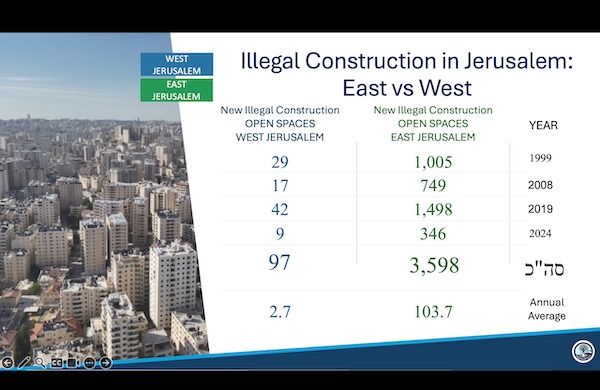
“These areas were meant to serve as Jerusalem’s development reserves,” Noam said. “Instead, years of neglect have allowed illegal building to spread unchecked… not to mention the loss of natural landscapes, heritage sites, and the urban and security challenges that come with it.”
A Structural Failure — and a Narrowing Window
The study refutes frequent claims that illegal construction stems from overcrowding. Regavim’s surveys found that several neighborhoods with high rates of illegal construction actually have some of the lowest population densities of any urban area worldwide.
“Despite the significant progress made under Mayor Moshe Lion and Minister Itamar Ben Gvir — including doubling enforcement and halving the rate of new illegal construction — the severe inequality of enforcement cannot continue,” Noam says.
The enforcement agencies echoed these concerns.
Avi Cohen, Director of the National Enforcement Unit, highlighted progress but warned of deeper issues: “Enforcement has improved dramatically, but the main issue is a ‘decision not to decide.’ Once responsibility is clearly assigned, the situation will look very different. For now, we’re merely maintaining the status quo.”
Moshe Wolanovitz, from the Land Resource Enforcement Unit, added that thousands of structures with final demolition orders remain untouched due to legal delays enabled by Section 207 of the Planning and Building Law.
Knesset Committee: Illegal Construction is a National Challenge
Committee Chair MK Yitzhak Kroizer described illegal building in open areas as “a clear political maneuver to change the character of the State of Israel.” He warned that the damage is already severe: “The land on which illegal construction is taking place burdens infrastructure, education, drainage — and the destruction of open spaces that do not belong to any political side.”
Municipal representatives said that while Jerusalem supports greater density and urban renewal, effective planning solutions in East Jerusalem require significant government support.
A Call for Coordinated Action
The committee concluded with several demands:
• Uniform enforcement across East and West Jerusalem
• Advancement of pending legislation, including sanctions for unlicensed contractors
• An inter-ministerial roundtable bringing together municipal authorities, enforcement units, police, the Israel Land Authority, the Justice Ministry, and environmental agencies
• Clear timelines from the Ministry of Jerusalem Affairs for new statutory planning processes
There is room for optimism, Noam explains. “Our report calls for immediate action and includes detailed operational recommendations for government and municipal authorities. Only if we look at reality squarely in the eye and join forces to combat this problem, can we change this trajectory.”
Related Posts
THE SHOWCASE HOMES THE WORLD DOESN’T WANT YOU TO SEE
Pools. Fountains. Marble staircases. Sprawling estates. Regavim spent one day documenting Palestinian luxury homes across Judea and Samaria. The result is a striking new book challenging one of the international community’s most persistent narratives about life in the region. What does Palestinian life in Judea and Samaria really look like? A new photographic investigation by […]
A New Dawn in the Battle for Judea and Samaria
Meir Deutsch, Director General for The Regavim Movement Published in Israel Hayom, December 18th, 2024 For the first time in a decade, there’s been an unprecedented decline in illegal Palestinian construction in Area C, coupled with a significant increase in enforcement actions by the Civil Administration. This isn’t just a statistic; it’s a beacon of […]


