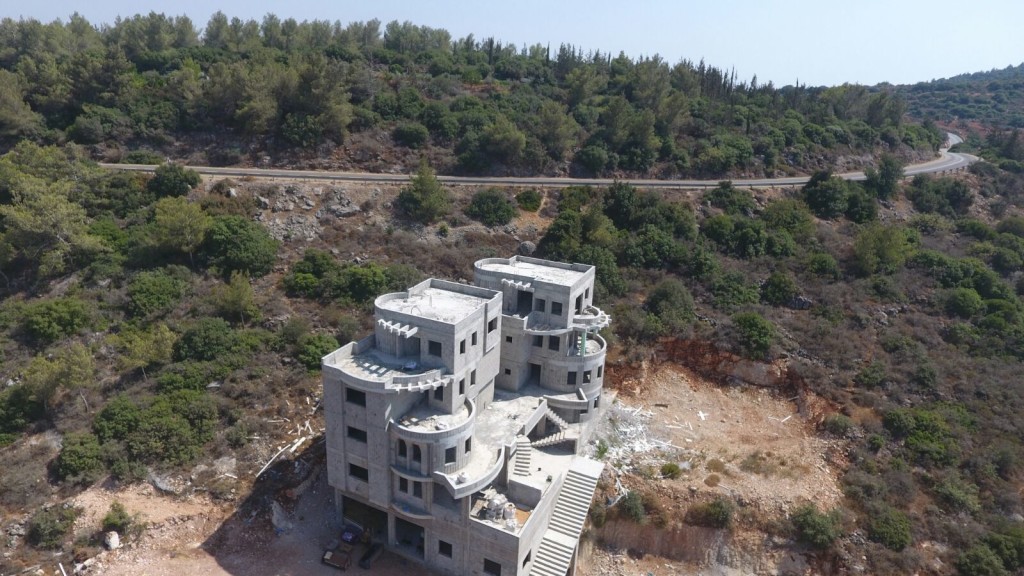
IDF Firing Zones 917 and 918 are situated in a strategic area in the South Hebron Hills, a region that connects Israel’s eastern flank to the Negev and the Dead Sea.
For the past few years, a massive take-over of land in this area has been underway, and we at Regavim have made a major effort to combat the phenomenon and have the squatters removed. In Area 918, for example, we submitted a petition against an entire village, Halet al Dabaa, which was constructed illegally by the European Union.
We also petitioned the Supreme Court last year regarding an illegal road that had been paved, in another attempt to create facts on the ground and fulfill the Fayyad Plan’s vision of connecting Gaza, the Negev, and the Hebron Hills and create territorial contiguity that would effectively amputate the Negev from Israel.
***
This week, in response to our petition, the High Court of Justice issued an order to halt illegal development activities on IDF Firing Grounds 917 and 918.
We welcome the High Court’s clear pronouncement and hope it will be the first step toward halting this catastrophic plan.
ב' סיון התשע"ח - 16 May 2018
Share:
Bir Hadaj: A birds-eye view
Today (May 16), the Israel Police and General Security Service (Shabak) announced the capture and arrest of a crime and terror cell from the Bedouin town Bir Hadaj in the Negev. All five suspects have been charged with damaging the IDF’s security installations on the Israel-Egypt border in order to facilitate their drug-smuggling operation.
Regavim would like to remind the public: Bir Hadaj has long been the crime and drugs capital in the Negev. We’ve reported on bands of marauders from Bir Hadaj who infiltrate the IDF base at Tze’elim, stealing everything they can get their hands on, from weapons and ammunition to the personal belongings and private cars of soldiers serving on the base. We’ve reported on the hothouses that have sprung up on the training grounds at Tze’elim, where a well-known crime family from Bir Hadaj has been growing marijuana – an operation exposed by Regavim’s hidden camera. The theft and vandalism that has battered nearby Kibbutz Revivim also originates in Bir Hadaj.
Let’s also not forget that most of the houses of Bir Hadaj were built illegally, on Jewish-owned land that was seized by force. “The lawful owners of the land, represented by Regavim’s legal department, petitioned the District Court as well as the Supreme Court, but their land has not been returned to them.”
Following a legislative initiative over a decade in the works, the Knesset last week passed the “Kaminitz Law,” granting the state greater authority when it comes to enforcement with regard to construction violations throughout the country.
The legislation, known as amendment 109 of the Planning and Building Law, which passed 43-33 in a special session held during the Knesset’s Passover recess, is a game changer.
The new law was introduced by the government following recommendations by a committee led by deputy attorney-general Erez Kaminitz, who sought ways to deal with the plague of illegal building in Israel.
The law gives the National Building Supervision Unit the power to supervise the work of the local municipalities, which until today went unchecked.
What you had was a phenomenon in which local mayors would simply ignore building violations.
The law also provides building inspectors with greater authority to stop illegal building dead in its tracks as soon as the construction commences. In addition the law calls for a huge increase in fines for building without a permit.
Our organization, Regavim, has been working on passing this type of legislation from the very beginning to help change the situation on the ground when it comes to the enforcement of building laws in this country.
The law also lessens the bureaucratic nightmare prevalent for decades, in which those who knowingly build illegally were aware that if they played the “game” right, they could continue to make use of their illegal structures, whether homes, offices, or storage spaces, since appeal after appeal in the courts would lengthen the period of inaction, or lack of enforcement, for years at a time.
The Arab MKs are protesting against this new law, claiming that the state doesn’t allow the Arab population to build legally in their communities, hence they are forced to resort to illegal building. Regavim is aware of this recycled false narrative.
Taking a step back, obtaining a building permit throughout all of Israel is a multi-step process. Firstly, the National Building Planning Administration designs the overall layout of any given city or town.
Certain areas are designated for housing, other areas for open spaces, industry, agriculture etc.
Once that city plan is approved, the municipalities or private developers seeking to build in the recognized building areas must come forward with their detailed construction designs. The city then takes the detailed plan back to the building administration for final approval. Once that happens building can commence.
However, according to Regavim’s research, in 95% of the Arab towns and villages in northern Israel (where the majority of the Arab population resides), while the state has in fact put together long-term city plans, the local Arab municipalities don’t utilize those plans. It is for this reason that the residents of these areas are unable to obtain the proper building permits.
Whether it’s a lack of funds due to a failure to collect property taxes (arnona), or tensions between clans and tribes who fight over designated building areas, the municipal or private developers’ plans aren’t being brought for approval.
In other words, it’s not the state’s fault; the onus is on the local officials who aren’t taking responsibility for the construction demands of their populations.
As a result you get Arabs who resort to illegal building without approved plans. When the state points out the violations and seeks to demolish the illegal construction, it becomes the bad guy.
And that’s where the necessary new law comes into play – it allows for swift enforcement, before the above-mentioned scenarios can cause outbreaks of illegal construction.
As mentioned, while Arab MKs were critical of the new law, Prime Minister Benjamin Netanyahu expressed the exact opposite sentiment, showing his strong support for the legislation as a means to integrate the Arab population into Israeli society.
As he stated, “The government which I head has invested, and continues to invest more than any other [previous] government in the Arab sector in order to close the existing gaps – in education, wages, culture, as well as health.
“Israeli Arabs want to be a part of the State of Israel, they want to be a part of the prosperity of Israel’s economy, they want to be a part of the future of the State of Israel, of all the citizens of Israel, and therefore we are investing like no government before us has done. We want the integration of the Arab public into the State of Israel, but that also means integrating with the laws of the State of Israel.”
It’s important to note that the prime minister stressed that the new law wasn’t targeting Arabs only, but that enforcement of the law would be applied equally in all sectors.
“One state, one law, one enforcement. This is what we did today, and I thank you for the passage of this important law,” the prime minister concluded.
For Regavim the passage of the law was viewed as a major success. Leaders of the NGO said they were hopeful that law enforcement authorities would actively utilize the tools granted to them by the new legislation to strengthen the sovereignty of the State of Israel over all of its land.